


It looks apocalyptic. Clouds. Eyes. Mourning tribes. The cosmic A and Z.
Most readers see Revelation 1:7-8 and brace for spectacle. Treat it as the dramatic chord struck before the symphony begins. The opening fanfare of the strange book.
That reading misses what is actually happening on the page. Yochanan is not generating original imagery here. He is quoting. Twice in two verses. From two different prophets. And then he closes with a self-designation for HaShem so distinctively Hebraic that Greek translation cannot carry it.
“Look! He is coming with the clouds! Every eye will see him, including those who pierced him; and all the tribes of the Land will mourn him. Yes! Amen! ‘I am the ‘A’ and the ‘Z’,’ says ADONAI, God of heaven’s armies, the One who is, who was and who is coming.”
Revelation 1:7-8 (CJB)
Two verses. Three Tanakh citations. One alphabet.
The Cloud Rider
“Coming with the clouds” is not generic apocalyptic decoration. It is Daniel 7.
Daniel 7:13 (CJB): “I kept watching the night visions, when I saw, coming with the clouds of heaven, someone like a son of man.” בַּר אֱנָשׁ (bar enash). Aramaic. A figure approaching the throne room of the Ancient of Days. Verse 14: dominion is given to him. Glory. A kingdom. All peoples and nations and languages serving him. An everlasting kingship that shall not pass away.
This is the courtroom of the Ancient of Days. And the cloud-rider walks in to receive His own.
Yeshua used “Son of Man” of Himself more than eighty times in the Gospels. He was not picking a humble self-designation. He was claiming Daniel 7. When the high priest demanded under oath whether He was the Messiah, the Son of God, His answer was the cloud-rider verse (Matthew 26:64). That is what tore the high priest’s robes. Not a generic claim to messiahship. A specific claim to Daniel 7’s enthroned figure.
So when Yochanan opens with “He is coming with the clouds,” he is not inventing imagery. He is invoking a verdict already rendered in Daniel’s vision. The trial is already scheduled. The cloud-rider is already on the docket.
The Pierced One
“Including those who pierced him” is not a Roman soldier reference smuggled in. It is Zechariah 12:10.
Read the Hebrew of Zechariah 12:10 carefully. HaShem is speaking in the first person throughout the oracle. Then this: v’hibitu elai et asher dakaru (וְהִבִּיטוּ אֵלַי אֵת אֲשֶׁר־דָּקָרוּ). “They will look at Me, the one they pierced.” The pronoun does not waver. The speaker is HaShem. The pierced one is HaShem.
This verse has caused two thousand years of theological vertigo for anyone trying to flatten the Hebrew text into tidy categories. The Masoretes preserved it. The targumists wrestled with it. Western theology mostly trains its readers to skip past it.
Yochanan does not skip past it. He puts it in his second sentence.
And then he completes the citation. “All the tribes of the Land will mourn him.” Zechariah 12:11-14 lists those tribes by name. The family of the house of David. The family of the house of Natan. The family of the house of Levi. The family of the Shim’i. Each by themselves. Each woman by herself. The mourning of Israel turning back. Teshuvah in the form of grief. National repentance shaped like a funeral.
Yochanan is telling Asia Minor: when this scene plays, it plays in the language of Zechariah, not in the language of Roman conquest narrative. The mourning is covenantal. The mourning is Israel’s. The mourning is the moment HaShem’s people see who it is they wounded.
The Aleph and the Tav
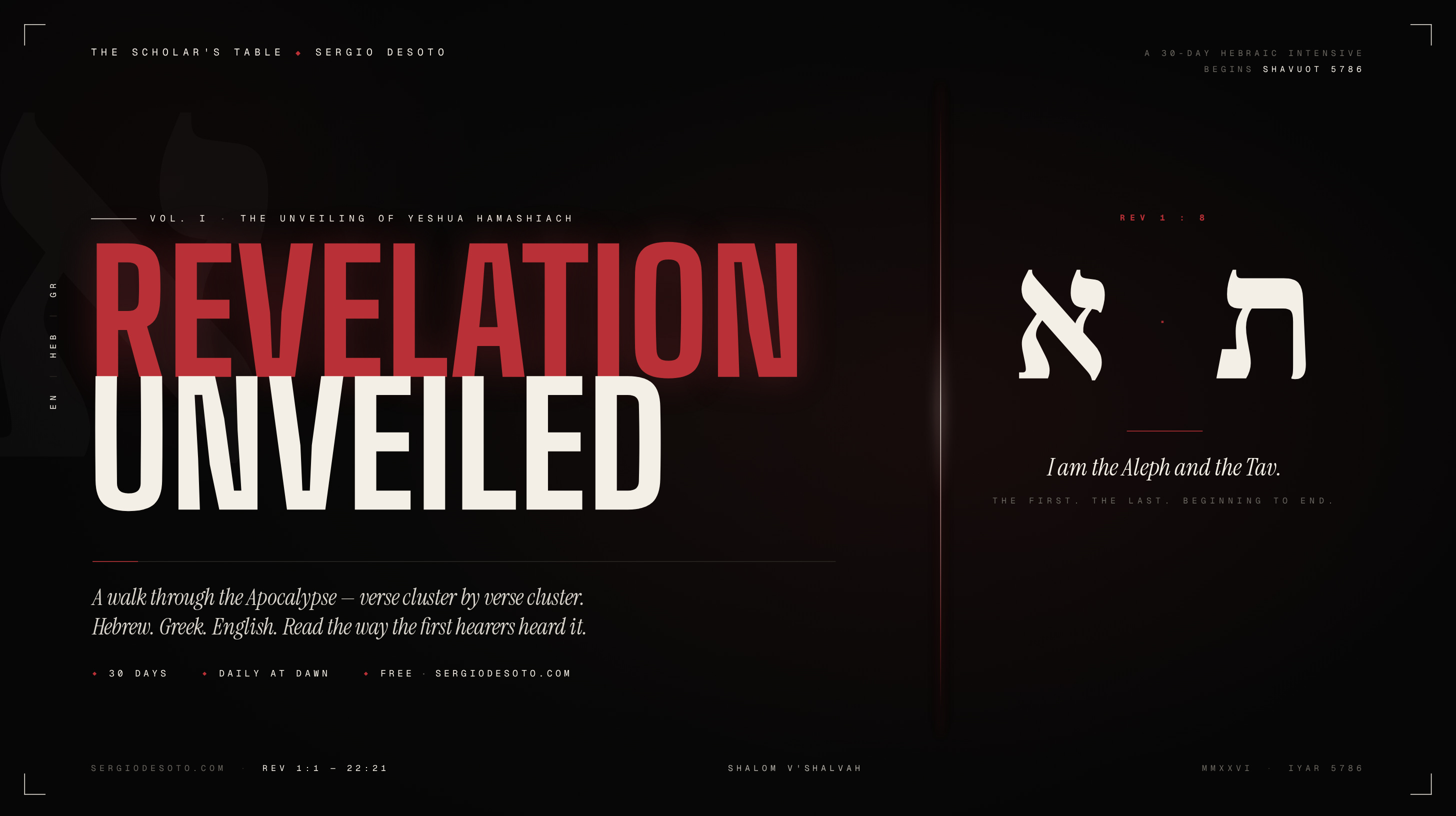
CJB renders verse 8 as “I am the ‘A’ and the ‘Z’” because the underlying Greek says ἄλφα and ὦ (alpha and omega). The translators are doing English readers a favor. Bookends. First letter, last letter.
What CJB cannot do, and what no English translation can do, is carry across what Yochanan was actually thinking when he wrote it.
He was thinking Aleph (א) and Tav (ת). He had to be. He was a Galilean Jewish prophet whose first language was not Greek and whose mental furniture was Tanakh. Greek had no theological tradition built around alpha and omega. Hebrew had centuries of contemplation built around Aleph and Tav.
The Aleph and the Tav are not just alphabet bookends in Hebrew. They form the word אֵת (et), the direct object marker. Et appears more than seven thousand times in the Hebrew Bible. It is the most common particle no English translation can show you, because grammatically it does not translate. It points. It marks. It tells you what is being acted upon.
And the very first verse of Tanakh uses it twice.
Bereshit bara Elohim et hashamayim v’et ha’aretz (בְּרֵאשִׁית בָּרָא אֱלֹהִים אֵת הַשָּׁמַיִם וְאֵת הָאָרֶץ). “In the beginning God created [et] the heavens and [et] the earth.” The Aleph and the Tav stand on either side of the heavens. The Aleph and the Tav stand on either side of the earth. The first and last letters bracket creation itself.
There is a midrashic tradition, very old, that the et in Genesis 1:1 is the Messiah present at creation. You can take that reading or leave it. But you cannot leave this: when Yochanan reaches for HaShem’s self-designation, he does not reach for “First and Last” as an abstraction. He reaches for the two letters that have been bracketing every direct object in the Hebrew Bible since bereshit.
The Aleph and the Tav are not poetic bookends. They are the grammatical scaffolding HaShem has been writing through the entire Tanakh.
And Yeshua, in this verse, is identified with that scaffolding.
The Compositional Move
Look at what Yochanan has done in just two verses.
Daniel 7. Zechariah 12. Genesis 1. The cloud-rider, the pierced one, the Aleph-Tav.
He is not writing apocalyptic theater. He is writing an inhabited cento. A tapestry of Tanakh citations addressed to people whose memories were saturated with those citations. The first hearers did not need footnotes. They heard Daniel when he said clouds. They heard Zechariah when he said pierced. They heard Genesis when he said Aleph and Tav.
If Western theology hears these verses as new revelation springing from nowhere, it has not been listening to the verses long enough. Yochanan never stops citing. The Apocalypse is the most densely Tanakh-saturated book in the Brit Chadashah.
Pull up Daniel 7:13-14. Pull up Zechariah 12:10-14. Pull up Genesis 1:1 in any honest interlinear that shows you the et. Read them in that order. Then read Revelation 1:7-8 again. See whether what I am telling you is what is actually on the page.
Do not take my word for it. Take the text’s.
Selah
If every dramatic image in Revelation is quoting older Scripture, what does that change about how you have been reading the book?
When Zechariah 12:10 puts HaShem on the receiving end of the piercing, and Yochanan applies that verse to Yeshua, what is the text asking you to hold together that your framework may have taught you to keep apart?
If the Aleph and the Tav have been bracketing creation since the first verse of Tanakh, what does it mean for you that Yeshua identifies Himself with those two letters?
And the harder question: have you been reading Revelation as a book about the future, or as a book about the One whose Name has been written into every page of the Tanakh from bereshit onward?
Shalom v’shalvah. Your brother in the Way, Sergio
This is Day 3 of Revelation Unveiled, a 30-day Hebraic intensive walking through the Apocalypse verse cluster by verse cluster. The Inner Circle opens after the intensive!
Reserve your spot: click here
Love it! Thanks, brother. It's called the revelation (revealing) of Yeshua. It's what you say it is, BUT it's also about the soon-coming future. All you have to do is ask Him and He'll tell you that.
I love "The Compositional Move." People want to argue about the God of the OT and the God of the NT. This is mind blowing to them!!! People reading Zechariah 14 which describes the second coming of Messiah, but the name YHVH is hidden in their bibles as "The LORD" which gets conflated with the title often given to Jesus "the Lord." How are most Christians going to reconcile the second coming of Yeshua with YHVH in Zechariah 14? Boom!!!!