

You’ve seen the image ten thousand times.
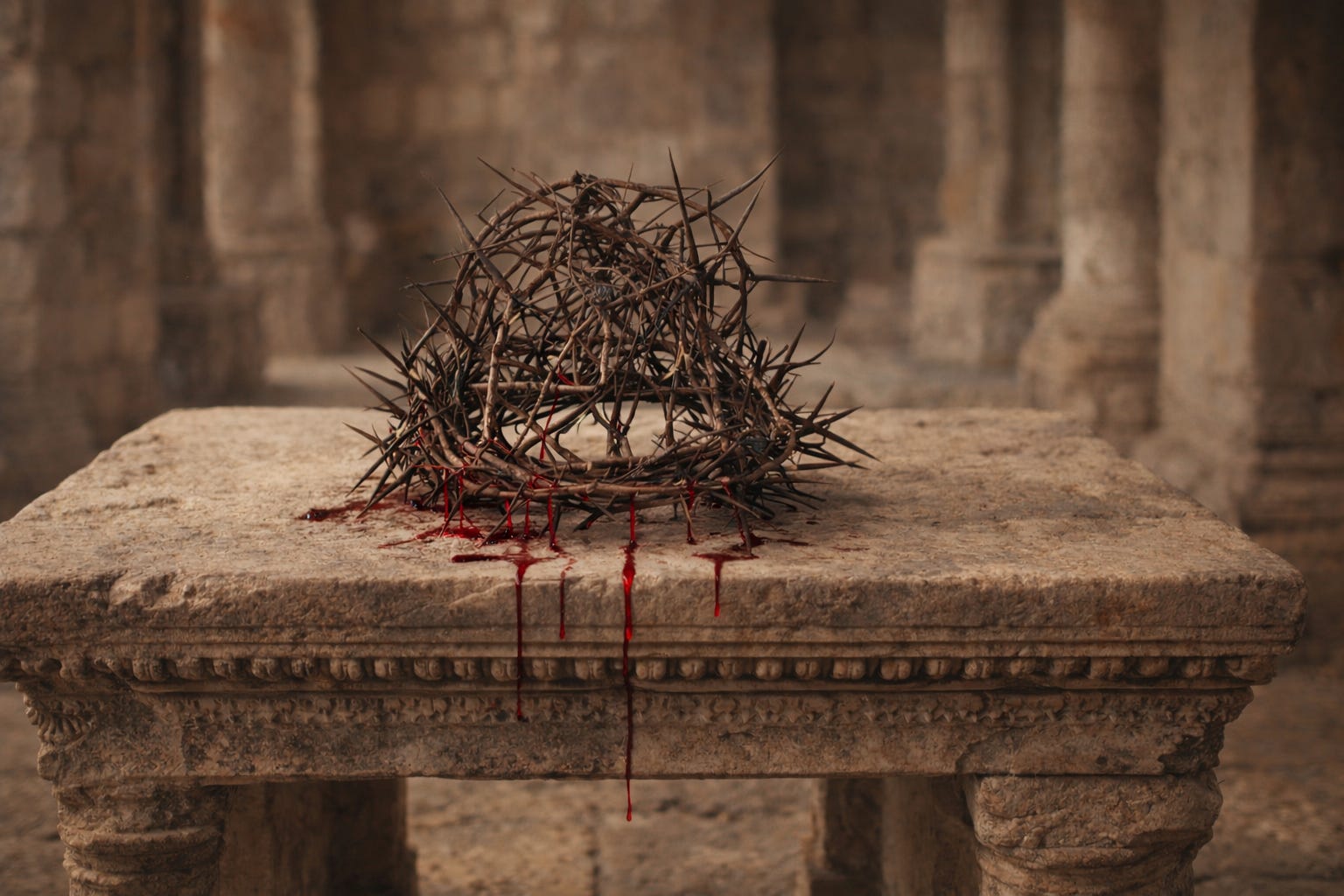
A slender ring of thorns. A bowed head. Drops of blood, tastefully rendered.
Here’s what I need you to sit with: that image is not in the text.
The Gospels tell you the thorn-crown existed. Matthew 27, Mark 15, John 19 — all three place it on his head inside a mock-coronation sequence that included flogging, a purple robe, a reed scepter, repeated blows to the head, and soldiers kneeling in staged mockery of a king.
They do not give you a diagram.
The circular wreath is a Byzantine and Renaissance iconographic tradition. Not a biblical claim. Which raises a question most people have never thought to ask: what if it was something more engulfing than a ring? What if the thorn structure covered more of the head — more like a helmet — and the devotional image we’ve inherited is smaller than what actually happened?
That question is the door to something much larger.
Unpacking #13 reads the crucifixion forensically. It works through the Greek word stephanos, Roman military ridicule, Tacitus, Josephus, the archaeological remains of a first-century crucifixion victim, and the fractured crowd at Golgotha that most Christian preaching flattens into a single emotional bloc.
And then it goes somewhere else entirely — into Leviticus and Jeremiah 31, where the cross stops being a symbol and starts being a covenant event. The deepest, bloodiest, most misread covenant event in history.
The full essay is on the site. Go read it.
→ [Read Unpacking #13: The Crucifixion — We Made It Pretty. It Wasn’t.]
Paid subscribers — Behind the Text goes deeper on the stephanos/diadema question and what I held back from the public piece. The Root follows the week after: a full word study on mishhat (מִשְׁחַת) — the Hebrew word in Isaiah 52:14 that says more about the crucifixion than most systematic theologies ever will.
If the paid tier isn’t accessible to you right now, message me. No one gets left out for financial reasons.
Shalom v’shalvah,
Sergio
As I listened to the first third, I was thinking; People who read Job and comment about the suffering or injustice…. do they experience the horrific tortures of Jesus more lightly without realizing it. Is there an emotional disconnect? This comes to mind only because you describe the decorations and ornaments of the cross.
I have benefited from everything put out thank you. This was awesome.