

One morning I sat at my kitchen counter with a cup of coffee and 1 and 2 Timothy open, reading slowly. I had read those two letters for years, as they have been commonly accepted. That morning Sha’ul (Paul) made sense, line after line, and nothing in or about him had changed.
Here is the text as it stands. “We know that the Torah is good, if a person uses it lawfully, knowing this: that the Torah is not laid down for a righteous one, but for the lawless and insubordinate,” 1 Timothy 1:8-9, and then a list that runs to the end of verse 10. Six verses later the same pen writes, “Messiah Yeshua came into the world to save sinners, of whom I am the foremost,” 1 Timothy 1:15. And the first psalm says of the righteous man, the tzaddik, כִּי אִם־בְּתוֹרַת יְהוָה חֶפְצוֹ, his delight is in the Torah of YHWH, and on His Torah he murmurs day and night, Tehillim, Psalms 1:2.
Most of us were handed verse 9 with its accepted meaning already attached, and people who loved me did the same; that is how it was presented to me. The Torah is not for the righteous. I have been made righteous by trusting Yeshua (Jesus), so the Torah is not for me; I am forgiven for everything I have ever done, and obedience and repentance are not conditions of anything. A sincere man can preach that for thirty years and point to the verse every time, and he is not lying; nearly every clause of it is true.
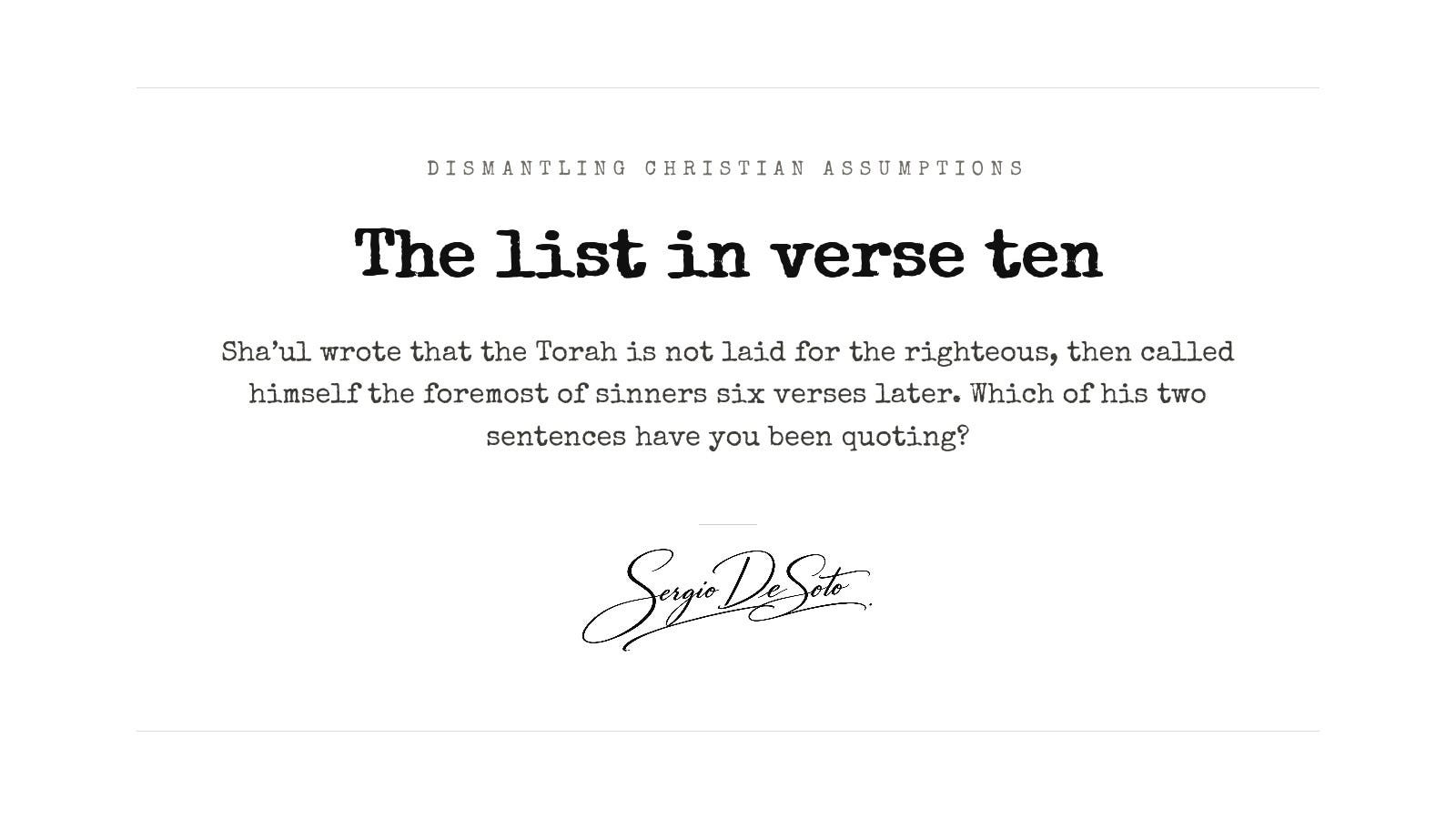
Set the three passages side by side, and something does not sit right. Verse 9 says the Torah is not laid down for the righteous one. The psalm says the righteous one delights in the Torah day and night, which is a strange thing to say of a man it was withdrawn from. And the apostle who wrote verse 9 would not take the seat it describes; he put himself at the head of the list on the other side of the sentence. If the same man wrote both, which of his two sentences have you been quoting?
The word to carry is tzaddik, צַדִּיק, the righteous one, the person-noun of tzedek. The way I take this, the Tanakh never hands the title to a man who claims it; it shows him by his walking, and the first psalm describes him by where he does not walk, stand, or sit, and by what he delights in. The Greek under 1 Timothy 1:9, dikaios, is the Greek Tanakh’s word for that same man. Whether the tzaddik is a standing a man reaches or a road he keeps, and what that does to verse 9 in the mouth of the pulpit that quotes it, is the essay’s work, and I would rather you reach it with the chapter open than take it from me.
I read these two letters for years as what they had become. Then one morning at my kitchen counter, coffee in hand, reading slowly with the context on, Sha’ul made sense, and nothing in him had changed; what had changed was how I was reading. The smallest thing I can ask is twelve minutes tonight with your own Bible open: all of 1 Timothy 1, verses 1 to 20, then Shemot, Exodus 20:2-17, then Tehillim, Psalms 1:1-3, in that order, and no one reading them to you.
What waits in No One Makes the Mark is the list in verse 10 read beside the mountain, Sha’ul’s own résumé set beside the one word he used for his years, and the dates on which the release reading was tried and lost. The verses are laid out for you to check.
Your brother in the Way,
Sergio
Every article on this Substack is free, and it will stay free. If you choose to pay for a subscription, nothing here unlocks.
Your paid subscription gives you a paid seat at The Berean Table, and it helps carry this work. To take your seat, register at the Table and send me a direct message here once you have; I open it by hand.


Here's my homework Sergio:
Sha'ul thought he was following the Torah when he persecuted the followers of Yeshua. In doing so, he was NOT following the Law lawfully and therefore needed the Law.
The Law had never changed (Exodus 20) and still has not changed. There are those 'happy ones' (Psalm 1) who do live by the Law and therefore do not need It since they do not stray. But Sha'ul strayed from It by wanting to enforce the statutes of the Law violently (effectively usurping God's role of judge by misinterpreting It ("they do not know what they are talking about or what they so confidently affirm" 1 Tim 1:7).
Paul considered himself (Sha'ul) the greatest of sinners because he did not understand the Law despite knowing the letter of It and because Yeshua ha Massiach appeared to him changing him into Paul who "with a pure heart and a good conscience ... and holding onto faith" walked in the Law (Exodus 20).
Sha'ul, reborn in the Spirit as Paul speaks to Timothy and to us acknowledging his sin and his change through God's mercy. At no point is he contradicting himself or the Law as he used to before Christ intervened in his life.
As Sha'ul, he did not follow the Spirit of the Law but Its letter. As Paul he walked in the Spirit and no longer needed the Law.
"But now we have been released from the law, having died to what confined us, so that we serve in the new way of the Ruach and not in the old way of the letter." Romans 7:6
Am I reading this right?