


People invite me to church. I go.
I am not a fan of institutional Christianity, and I do not believe it is biblical. I have told that to the people who ask me, and I will not hide it from you. But when someone asks me to come, I come, and I bring a notebook. I always leave with something. It is rarely Scripture. More often it is the distance between what was said and what the text actually carries, and that distance teaches me as much as a good sermon would.
This evening it was the word zamar.
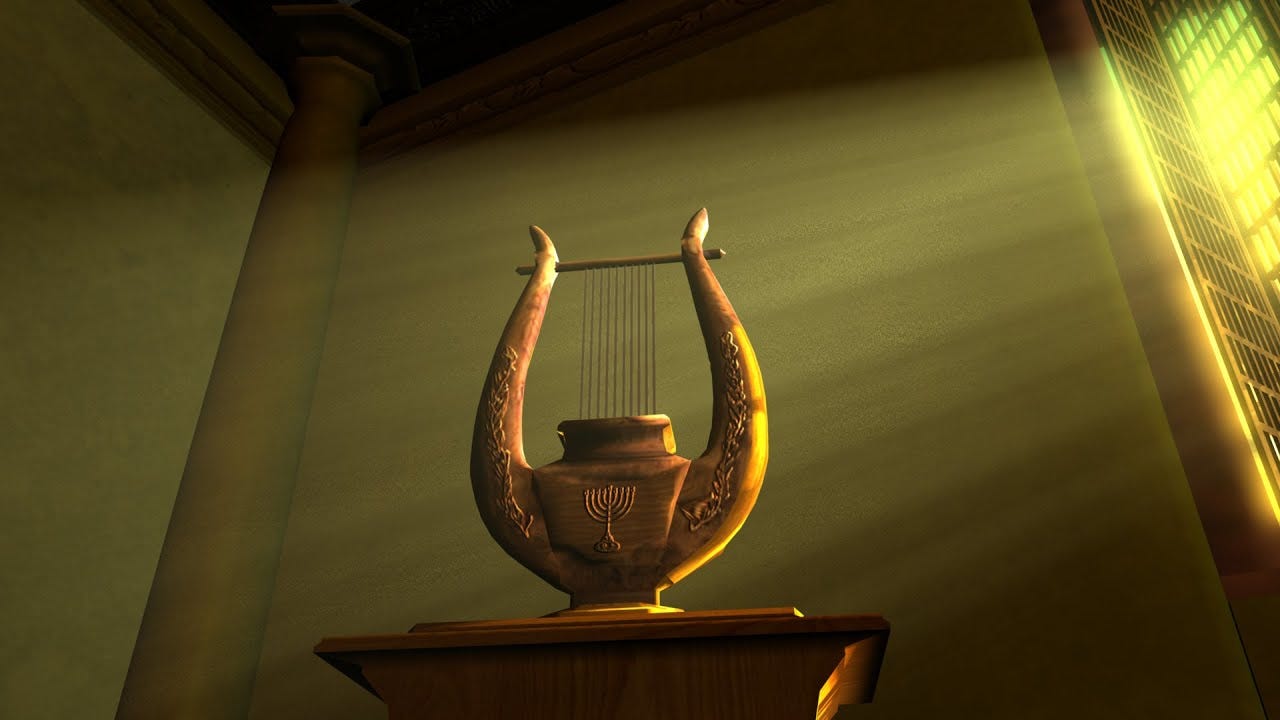
The pastor built his message on three Hebrew words for worship: yadah, halal, and zamar. He even named the complexity of Hebrew out loud, which is more than most are willing to do. Then he flattened zamar into the ten-stringed instrument and moved on. The whole hour was worship, worship, worship, and what Yeshua (Jesus) died to purchase for the worshiper. They sang “Jesus Paid It All.” The gospel underneath the music was penal substitution.
I texted the leader of the men’s group afterward, a good friend of mine at this church, and told him what zamar actually holds. Then I sat with it, because the misconception runs wide. Most people use zamar to mean singing with an instrument, and they stop there.
It carries far more than that. And the rest of what it carries turns a worship song into something with an edge.
Western worship has a vocabulary problem.
The English word “worship” is asked to carry too much, and what it carries is mostly emotional. Lift your hands. Feel something. Be moved. The vocabulary betrays the assumption: worship is a state I enter, an experience I have, a posture of the heart that produces, hopefully, a feeling I can hang on to.
The Hebrew Bible has a different vocabulary. Several distinct verbs for praise, each one carrying a posture the others do not. Halal is the boisterous noise. Yadah is the lifted hands and confession. Barukh is the bent knee. Todah is thanks offered as sacrifice. Tehillah is sung praise that became the title of an entire book.
And then there is zamar.
The Word
Zamar (זָמַר) is the verb most translated “to sing praises” or “to make music.” It is the characteristic verb of the Psalter. Zameru l’YHWH chasidav. Sing praises to HaShem, you faithful ones. Azamerah l’shimkha Elyon. I will sing praises to Your name, O Most High. Zamru Elohim zameru, zamru l’malkenu zamru. Sing praises to God, sing praises. Sing praises to our King, sing praises. Tehillim [Psalms] 47 piles the verb five times in two verses, as if the psalmist cannot find a synonym strong enough.
So far, this is what most worship leaders teach when they reach for zamar. The musical verb. The stringed-instrument verb. The praise verb.
What most do not teach is that the same root also means to prune.
ז־מ־ר (zayin-mem-resh). The verb the Torah uses in Vayikra [Leviticus] 25:3-4 when HaShem instructs Israel about the vineyard: shesh shanim tizra sadekha, v’shesh shanim tizmor karmekha. “For six years you are to sow your field, and for six years you are to prune your vineyard and gather its produce.” The Sabbath year follows: lo tizmor. You shall not prune. Same verb. Same root.
The noun mazmerah (מַזְמֵרָה) is what the prophet Yeshayahu [Isaiah] sees beaten into the vineyard tool of the messianic age and beaten back out of it for war: pruning hooks. Yeshayahu 2:4. Yeshayahu 18:5. Yo’el [Joel] 4:10. The pruning hook is named for the cutting it performs.
So the Hebrew has a single root for two actions Western thought never connects: making music and cutting back a vine.
The rabbis noticed. Shir HaShirim [Song of Songs] 2:12 sets the ambiguity on the table deliberately: ha-nitzanim nir’u va-aretz, et ha-zamir higia. The flowers appear in the land, the time of the zamir has come. Is zamir singing (the next clause mentions the turtledove’s voice) or pruning (the agricultural context of early-spring flowers)? The classical commentators argue both ways because both are defensible. Rashi reads it as singing. Ibn Ezra acknowledges the dual sense. Hebrew did not need to choose. The season of singing and the season of pruning are the same season.
What the Vineyard Knows
A vinedresser does not prune dead wood. Dead wood breaks off on its own or gets cleared in winter cleanup. The work of zamar is performed on living branches. Branches that are growing. Branches that look healthy. Branches that have leaves and shoots and tendrils climbing the trellis, looking, to an untrained eye, like they are doing exactly what a branch is supposed to do.
The vinedresser cuts them anyway.
He cuts them because foliage is not fruit. Growth is not yield. A branch can pour all its sap into shoots and leaves that look impressively alive and produce almost no grapes. The pruning hook intervenes. The vinedresser reduces the branch so the remaining wood concentrates its sap into clusters. The vineyard yields more after the cutting, not less.
Yeshua draws on this exactly in Yochanan [John] 15:1-2 (CJB):
“I am the real vine, and my Father is the gardener. Every branch in me that isn’t bearing fruit he cuts off; and every branch that is bearing fruit he prunes, so that it may bear more fruit.”
Two cuttings. Dead wood is removed. Fruitful wood is pruned. The fruitful branch does not get spared the knife. It earns the knife.
His first-century Jewish disciples did not hear “prunes” as an abstract metaphor. They heard zamar underneath the Greek. The verb of musical praise was the verb of viticultural cutting. Their whole religious vocabulary had been telling them this for centuries.
What This Does to Worship
If zamar is both the song and the pruning, then to zamar God is to do two things at once. You are not just making music. You are presenting living wood to the vinedresser and consenting to His knife.
This is what Western worship culture is rarely told. Worship that does not prune you is not zamar. It is performance. It may be enjoyable. It may be moving. It may have excellent production value. But it has cut out half of the Hebrew word and kept only the harp.
The psalmist does not separate the two. When David writes azamerah l’shimkha Elyon in Tehillim 9:2, he is not picturing a concert. He is picturing a vineyard. The same hand that strikes the string holds the pruning hook. He is saying, with his music: cut me back. Take the growth that is not fruit. Reduce me where reducing produces yield.
And here is what the knife is for. The vinedresser does not cut to wound. He cuts to bring the branch closer to the vine. Yochanan [John] 15 is not finally about fruit as output; it is about abiding, about remaining in Him. The pruning clears away everything that was competing for the sap, so that what is left runs straight between you and Him. That nearness is the intimate worship a good worship team can never manufacture for you. You can stand in a beautiful room with your hands in the air, feel the music move through you, and still go home carrying the same distance from Him you walked in with. Or you can let Him cut, and walk out nearer to Him than any song could carry you on its own. The first is foliage. The second is fruit.
That is the posture zamar assumes. The branch that sings is the branch that is offered to the knife.
The Diagnostic
You can tell what kind of worship you are bringing by what comes off you when the song ends.
If nothing was pruned, nothing was zamar. Whatever happened was musical, perhaps emotional, possibly even sincere. It was not the verb the psalmist used. The vinedresser was not invited. The knife was not given permission to work. A gospel preached as a transaction, finished and paid in full, with nothing further asked of the worshiper, will tend to produce exactly this: a worship with nothing to surrender.
If something was pruned, then zamar happened. Maybe a self-image. Maybe a grudge. Maybe a calculation. Maybe an idol that had been growing alongside the genuine wood, stealing the sap. The yield will show up later. The vine will produce more in the next season.
The Father does not only prune dead wood when you sing. He prunes the alive parts that are not fruit. The good-looking growth. The respectable, defensible, ostensibly fine branches. He cuts them because He is after grapes, not foliage. He is after fruit, not the appearance of life.
When you stand up to worship Him, you are standing in the vineyard. The pruning hook is in His hand. The song is your consent. Consent to be brought closer. That is what the cutting was always for.
Selah
What has been growing in you that looks alive but is not bearing fruit?
What would HaShem have to cut back if your worship were actually zamar and not just music?
When was the last time you left a worship gathering with less of yourself than you walked in with, and counted that the gain?
If the Father is the vinedresser and the song is the knife, what are you singing tonight?
Shalom v’shalvah. Your brother in the Way, Sergio.
Another blessing of communication that gives deeper revelation to this older gentile lady who can’t get enough of who Yeshua is and how He desires to bring me ever closer . And all these years , I thought I was eating meat!
Thank you!!!
A comment from Chaim Bentorah
Don't be pressured into a certain style of worship such as singing and lifting your hands if that is not your heart. If you feel moved to sit, kneel or stand silently then let that be your praise.