

Sweet is the word the hymn chooses. Amazing grace, how sweet the sound. Sweet to whom? Ask that once and the song stops being background music.
Every Sunday, in tens of thousands of rooms, people sing this with their eyes closed and their hands open. Almost none can tell you who wrote it, when, or what he was doing while he wrote it. That is not their fault. It becomes their responsibility the moment someone tells them. So here is the telling.
Amazing Grace was written in 1772, in Olney, England, for a New Year’s sermon. Not on a slave ship. The ship is the version people prefer, because the ship makes it a rescue. It was not.
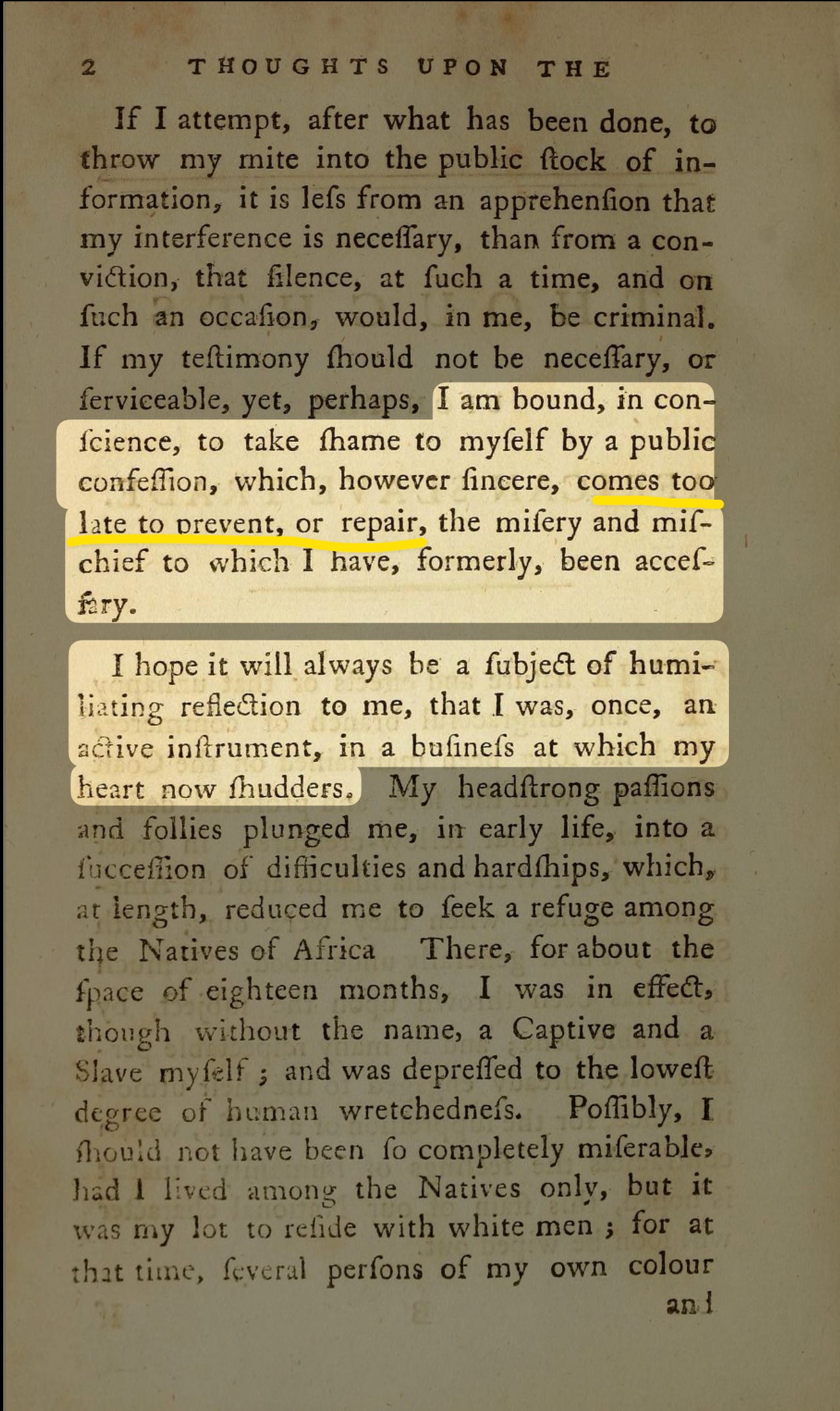
John Newton’s storm came in 1748. He called it his conversion. Then he went back. He captained slave ships after it. Three more purchasing voyages. When his health ended his sailing, he kept his money in the trade. Forty years passed between that storm and Thoughts Upon the African Slave Trade in 1788. Thirty-four of them came after his last voyage.
He kept logbooks. Careful ones. Names, numbers, cargo, mortality. And devotional entries in the same hand, on the same pages. He held prayer services on deck. Below the deck was the hold. His own later writing admits he abused enslaved women aboard those ships. When the pamphlet finally came he wrote that his heart now shudders. Read the tense. It did not shudder then, and then lasted decades.
Selah.
Sit with that. A man could pray on the boards and inventory the people beneath them, and nothing in him objected.
Now hold the hymn against it. It names a wretch and never names a sin. It celebrates sight and never sees a person. The many dangers, toils and snares are his own voyages, so providence is thanked for preserving the captain of a ship carrying human beings as freight. Grace teaches fear and grace relieves it, and nothing between those lines costs him anything. And when we’ve been there ten thousand years, in a stanza later singers grafted on, belongs to a we that was settled before anyone was born. The song kept growing in its own direction.
Then open Isaiah 58. They fast. They seek God daily. They delight to draw near. God refuses all of it and gives the reason: the yoke is still on someone’s neck. Amos 5 goes after the music by name. Take away from me the noise of your songs. I will not listen to the melody of your harps. But let justice roll down like waters. Micah 6:8 sets the standard: do justice, love mercy, walk humbly with your God. The hymn attempts one of the three, and only inward.
Before I go further, know where I stand. I hold no denominational card. No founder’s name, no confession, no catechism standing between me and the text. I am a Karaite Jew, which in the simplest terms means Scripture alone is the authority. Not the rabbis, not the councils, not Calvin. Where the text speaks, I listen. Where men have added, I do not. So what follows is not one tribe swiping at another. It is a question about what any system does when it arrives before Scripture does.
The mechanism. This is not a claim that Calvinists are wicked people. Many abolitionists were Calvinists. It is a claim about what the system permits. If your standing is fixed and unfalsifiable, conduct is decoupled from status. If everyone is wretched, then calling yourself a wretch names nothing in particular. If assurance never expires, no alarm goes off. A man can be genuinely devout and genuinely monstrous at once, with nothing in the framework alerting him. That is more disturbing than calling him a hypocrite.
There is something else here, and it deserves naming. Listen to how the confession actually works. I was so wicked, so lost, so wholly incapable, that God reached down and took me anyway, and I could not have refused Him had I tried. Say it slowly. It arrives as humility. It functions as exemption. If you were incapable of resisting, you did not choose. If you did not choose, you cannot be held to account. The most self-abasing sentence in the vocabulary turns out to be the one that quietly excuses you from the dock.
And consider what that permits on the water. A man may name himself the chief of sinners on Monday, sing of grace on Tuesday, and on Wednesday take a woman by force in the hold. Beneath the deck he prayed on. The wickedness was never a debt he was obliged to settle. It was the credential.
But press one step further, because the deeper problem is not psychological. It is covenantal.
Covenant is bilateral. Two parties, terms, obligations, consequence. Exodus 19: if you will obey my voice and keep my covenant. There is an if in the sentence. Deuteronomy 30 sets life and death before the people and commands them to choose. Joshua 24: choose this day whom you will serve. The entire architecture presumes a party capable of answering.

Unconditional election removes the second party. What remains is not covenant. It is decree. A verdict handed down before the defendant existed.
And that is precisely why the neighbor vanishes from the song. Covenantal obligation always runs in two directions, toward God and toward the man beside you. Read the Ten Words. Half of them concern your neighbor. Strip out the bilateral structure and the horizontal obligation goes with it.
So the hymn is not merely self-absorbed. It is covenantally incoherent. It celebrates a relationship with God that no covenant in Scripture would recognize.
Selah. The problem was never that he failed to feel. He felt deeply. He felt about himself.
And it did not stay on the ship. Around 1807 a Bible was printed for enslaved people in the West Indies with Exodus largely removed. No deliverance. No let my people go. What stayed was servants, obey your masters. Catechisms taught enslaved people that obeying the master was obeying God. In 1844 and 1845 the Methodists and Baptists split, and the southern side argued Scripture endorsed the institution. Genesis 9 was bent into the curse of Ham, marking a people as divinely assigned to servitude. In every case the category was decided first and the text was fitted to it afterward.
And watch how the story gets told from the platform. The atrocity, then the guilt, then the hymn. Cause, effect, resolution. It moves an audience because the arrow points somewhere clean.
The arrow points the wrong way. The atrocities were not behind him when he wrote. They were his trade. They continued after the storm, and his money stayed in the business long after the pen was down. The hymn was not written out of the wreckage of his past. It was written by a man who had not yet finished.
That is not a rounding error. It is a reversal. An ongoing crime is converted into a completed one so the song can serve as its resolution, and the congregation gets to feel the weight and feel it lifted, in four minutes, on behalf of someone who was still doing it.
Wake up. That is what gatekeeping is. Not a locked door. A rearranged timeline, handed to you already resolved, so you never ask what is still happening.

That is a gatekeeper. Not someone who forbids you the Bible. Someone who stands in front of it and tells you what it is permitted to mean. Newton could read Isaiah 58 and hear nothing about the hold, because the grid arrived before the text did. Sincerity was never missing. He had it. So did the men who bought his cargo. I said I hold no card. That is not neutrality. It is the refusal to let any man stand between me and the text. Every reader has a gatekeeper, and some of them sit unnamed in your own tradition. The question is whether you have ever tested yours against the text it claims to explain.
And now the gatekeeper has been automated. Ask a machine about this hymn today and it will hand you the resolved version by default. Not from a pulpit. Not with an altar call. Just a tidy summary that says he was looking back in horror at the man he used to be, sourced from video clips and ministry blogs, with the chronology quietly inverted and nothing marking it as a claim. It arrives as information rather than persuasion, which is what makes it more dangerous than any sermon. A sermon announces that it wants something from you. The summary does not.
One more thing. Some pulpits tell of a girl thrown overboard on one of Newton’s ships, and preachers use her death as the hinge of his repentance. I cannot document that story, so I will not use it. But watch what the telling does. It reaches for a dead child to make a white man’s interior life vivid. That is the hymn’s own logic, repeated from the pulpit.
The Bereans did two things. They received the word eagerly, and they examined the Scriptures daily to see whether these things were so. Most congregations have mastered the first half.
Newton was not a monster in a pew. He was a devout man with an unexamined framework, and that was enough. That is the warning. Not that wicked men sing. That sincere ones do, loudly, for decades, while the yoke stays on the neck.
You will sing again. Maybe this Sunday. And you cannot sing it the same way now, because you know what the mouth that wrote it was doing while it wrote. So ask the harder question, the one this piece was always about. What else are you singing that you have never examined? What did your teachers hand you already interpreted, already settled, already safe?
Newton did not lack devotion. He lacked one habit. He never made the system that comforted him answer to the text.
Do not inherit your worship. Examine it. Then sing.
Shalom v’shalvah, your brother in the Way,
Sergio
Sergio, this is a tough one to digest. I have always been the "yea but" guy in most theological discussions and can usually argue or find the points on both sides of an argument.
Like you, I try to stay away from theological labels or movements. I can see Calvin and Arminius in the scriptures. I also have decided at least for myself that there are many mysteries that God does not intend for us to unravel in this life or at least in the flesh.
As a musician and worship leader, I would be hard pressed to find any song writers I would know for sure or deem as "holy men". I have personally known some recognizable names and none of them without their "feet of clay". Even the Psalmist David wasn't a very consistent guy. Hot and cold I would say.
Then there was Mozart, Bach, and others with their Requiems. Handels Messiah. Most of those guys were not "living the Christian life" when they wrote their masterpieces.
In these modern times a good song writer is deemed a "rock star" while writing emotional drivel passed as "feeling the Holy Spirit". So...as a worship leader today, where do I draw the line on whose music I will sing? Its pretty safe to sing "Praise you Jesus" songs, but what if the writer is a secularist or of questionable character? Does that make what they wrote less meaningful to me the believer? Should we determine the theological background of every writer and make sure they line up with MY theology? I would admit there are some well known hymns of old that I am not comfortable singing...as well as some modern ones I see as totally errant or void of solid Christology.
In summary, I think your points are valid though I have not pursued the historical detail you have on Amazing Grace. I am not ready to throw out the song personally just because of Newtons human frailty of those times. I am just thinking that we would have to throw out more than half of all books and Christian hymns if the qualification was that a righteous person wrote them...nah maybe 99%. If I consider the realities of grace and my own up and down path of 7 decades, I know that God has used songs I wrote in the 70s to bless people even though I left the faith for a few decades. His grace was sufficient to bring me back around and it is only because of grace, not the law, that I returned. Even while I was yet (and am yet) a sinner, Christ died for me. He had and has a plan for me...and everyone else. Whether it was my choice or His calling that brought me back around, I will take either one...or both.
Wow. This - leaves me stunned. I have always loved this song - deeply. Idk how to feel about any of it or your essay. Sergio, this one will leave a scar. I don't dispute your scholarship, nor the truth you lay bare. I am just literally off balance with it. And then I have to ask - why have I never heard this? Ever. From any corner. And now I ask myself- is this another place I will need to research for myself? Which leads me to- Does anything I ever learned actually hold the meaning I was given? 🤨 I will have to sit with this for a very long while. The job of reconciliation will be lengthy. Sad but grateful for truth. 🙏🏻 Awakening like a butterfly- struggle- is good.