

Whether you realize it or not, you have been waiting for a Shofar your whole believing life.
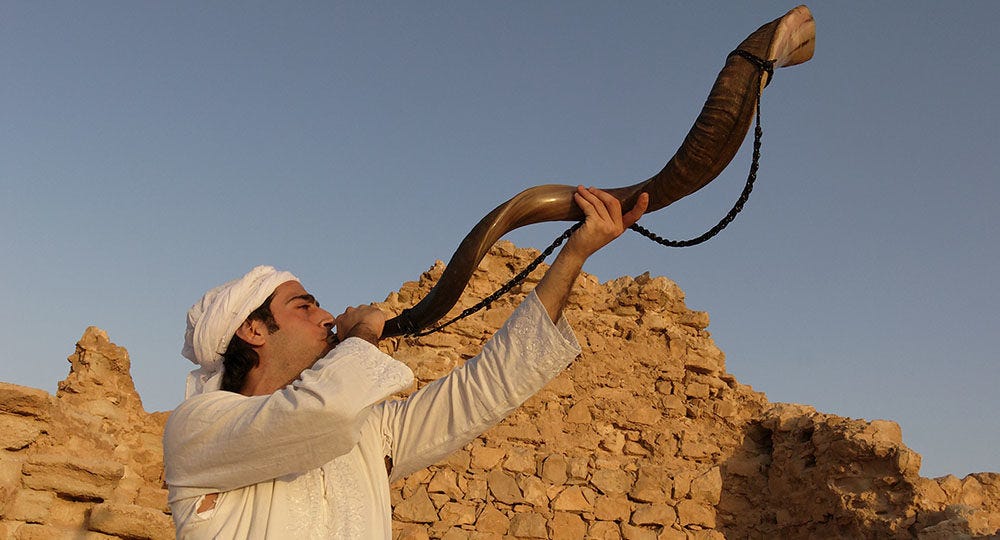
It is in the verses you memorized before anyone taught you what they sat next to: “For the Lord himself will descend from heaven with a cry of command, with the voice of an archangel, and with the trumpet of God”, 1 Thessalonians 4:16. “In a moment, in the twinkling of an eye, at the last trumpet”, 1 Corinthians 15:52. The hope you carry is trumpet-shaped. It has been ever since the first time somebody told you that Yeshua is coming back.
Here is what I bet nobody at church ever told you. Your Bible has a day on its calendar whose entire content is that sound, and guess what, it lands this week.
The Torah calls it a set day: “In the seventh month, on the first day of the month, you shall have a solemn rest, a memorial proclaimed with the blast of trumpets, a holy convocation”, Vayikra, Leviticus 23:24. And again: “It is a day for you to blow the trumpets”, Bamidbar, Numbers 29:1. Yom Teruah. The day of the blast.
Pay attention; I want you to notice something strange about it, because the strangeness is the invitation. Every other appointed day carries its reason on its face. Pesach remembers the night HaShem brought Israel out. Sukkot remembers the booths. Yom Teruah is given no stated reason at all. Rest. Blast. Remember. That is the whole instruction: a day made of sound and memory, with its purpose left open like a door.
For the waykeeper reading forward, that open door is exactly where the trumpet of 1 Thessalonians walks in.
One piece of honesty before we go further, because this table deals in honest weights. Your Jewish neighbors call this day Rosh Hashanah, the head of the year, and that name comes from the later tradition, not from the Torah, whose own new year for counting months arrives in spring, Shemot, Exodus 12:2. I say that without heat. Names drift in every house, mine included. But a waykeeper should know what the day’s own book calls it, and the book calls it the day of the blast.
Now look at whose day it is, because this is the real hinge. When Leviticus 23 opens the calendar, HaShem does not say “the feasts of the Jews.” He says: “the appointed times of YHWH, which you shall proclaim as holy convocations; they are My appointed times”, Vayikra, Leviticus 23:2. The word is moadim, appointments, from the same root as the tent of meeting. These are not one people’s cultural holidays that another people politely declines. They are meetings He set, and He calls them His.
And He has kept them on schedule. The spring appointments were kept to the day: Pesach, and the Lamb; the firstfruits, and the empty tomb; Shavuot, and the Spirit poured out on the very feast that remembers Sinai. When Sha’ul (Paul) calls the appointed times “a shadow of the things to come”, Colossians 2:17, the participle is present tense. Things still coming. The fall appointments are the ones that remain open, and the first of them is a day whose only content is a blast and a summons to remember. A phrase like “at the last trumpet” means little to a man with no calendar. To a man holding this one, it reads like a date circled in a hand he recognizes.
You were not told any of this for a reason, and that reason has a very real paper trail: the calendar was legislated away, at Nicea and after it, in the same generation that ordered believers to work on Shabbat. I have walked that history elsewhere and I am not walking it again today, because today I am not here to hand you a grievance. I am here to hand you an inheritance that has been sitting in your house unopened.
So hear the frame in context, brother, because this is the Way Forward lane, and I keep it constructive. This is not a new obligation arriving at your door; the council of Acts 15 said what it said, and I defend it. Nobody owes me a shofar. But when the real blast comes, the one your hope is shaped like, I want to be a man who recognizes the sound because he kept the rehearsals. That is what a moed is to a waykeeper. Not homework. A rehearsal dinner with the Bridegroom’s family, and your name was always on the list.
The particulars for this year, honestly given: the day begins at sundown this Friday, September 11. It falls on Shabbat this year, so most synagogues will hold the shofar until Sunday morning, and brothers who reckon by the sighted moon may land a day apart from the fixed calendar. Let the dispute stay small. The rehearsal is bigger than the reckoning.
Here is the whole assignment, and it costs ninety seconds. Friday at sundown, stop. Read Vayikra, Leviticus 23:23-25 and Bamidbar, Numbers 29:1 out loud. Then read 1 Thessalonians 4:16 out loud, and let those texts sit in the same room together, maybe for the first time in your life. If you can stand within earshot of a shofar this weekend, many congregations sound it Sunday, go stand there. That is all. No membership, no measuring. Just a waykeeper, learning the sound before the day he hears it for real.
Check out this awesome gift by Hebrew By Inbal
https://hebrewbyinbal.com/pages/greeting26
Selah
You have rehearsed for lesser things all your life: fire drills, weddings, the national anthem before a game. What does it say that the sound you are staking eternity on has a rehearsal you have never attended?
The one appointed day with no stated reason is the one filled with trumpet blasts. Sit with why the reason might have been left open.
And this Friday at sundown, when you read those verses aloud: what will you do differently while you wait, now that the waiting has appointments?
May the shalom of our Abba tune your ear to the sound, shalom v’shalvah.
Your brother in the Way,
Sergio.


Truly inspired. Truly a holy time. I wish I had started on this journey 50 years ago. I am sorry for all the other holidays that I celebrated that had nothing to do with God’s true appointments. I am definitely a late bloomer. Praise the Lord that the workers who arrived last in Matthew 20 got the same reward. There is hope and it is never too late to begin!
Thank you Sergio for allowing me to see Yom Teruah, the shofar, and the biblical calendar through a perspective I have not considered fully.